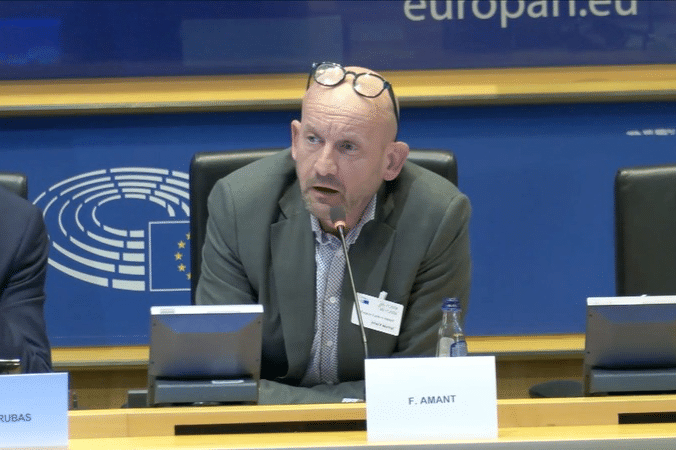
ESGO contributed to the European Parliament's Gender Equality Week on 9 November 2026, speaking at the Committee on Public Health (SANT) exchange of views on 'Gender inequalities in health prevention and research'.
Representing ESGO, Council Member Professor Frederic Amant outlined how gender inequalities affect research, clinical trials, and the cancer patient pathway.
Most medicines currently in use were approved based on clinical trials conducted mainly on men, leading to adverse drug events in women. These disparities cause 130,000 deaths among women annually and cost the EU €52 billion every year. Women are on average only 40% of participants in cancer drug trials, even in cancers that affect both sexes. And this number decreases from phase I to III. To address this, medical and research training must integrate sex and gender analysis, and systemic biases must be better defined.
Where a woman lives determines how she receives care. Death rates from cervical and uterine cancer are more than twice as high in Central and Eastern Europe as in Western Europe. Access to trials also differ greatly across member states: there are 0.14 cancer trials per 100,000 people in Albania, compared to 10.7 in Belgium. And one woman in five waits more than two months to start treatment – far beyond the recommended 30 days.
'Around 800,000 women's deaths a year could be avoided if every woman had access to high-quality cancer care,' said Professor Frederic Amant, ESGO Council Member.
Translating evidence into EU policy action
To close these gaps, ESGO urged EU policymakers to take decisive action across upcoming health and research frameworks. This requires:
- Protecting health research funding in the next EU budget and establishing a dedicated EU instrument for women's health research and innovation.
- Using the European Biotech Act to make trials fair through requiring sex-disaggregated data andenabling cross-border clinical trials.
- Funding an EU-wide network of Centres of Excellence in Women's Health.
- Translating the findings of the European Parliament's report on gender inequalities in health into measurable targets through a dedicated Women's Health Plan.
Professor Amant closed his speech with a quote from Anne De Middelaer, ENGAGe Co-Chair: 'Europe has the knowledge, the treatments, and the standards. The remaining barrier is equity. And equity is a policy choice.’